Nvidia Owns the AI Chip Market — But Is the Stock Right for You?
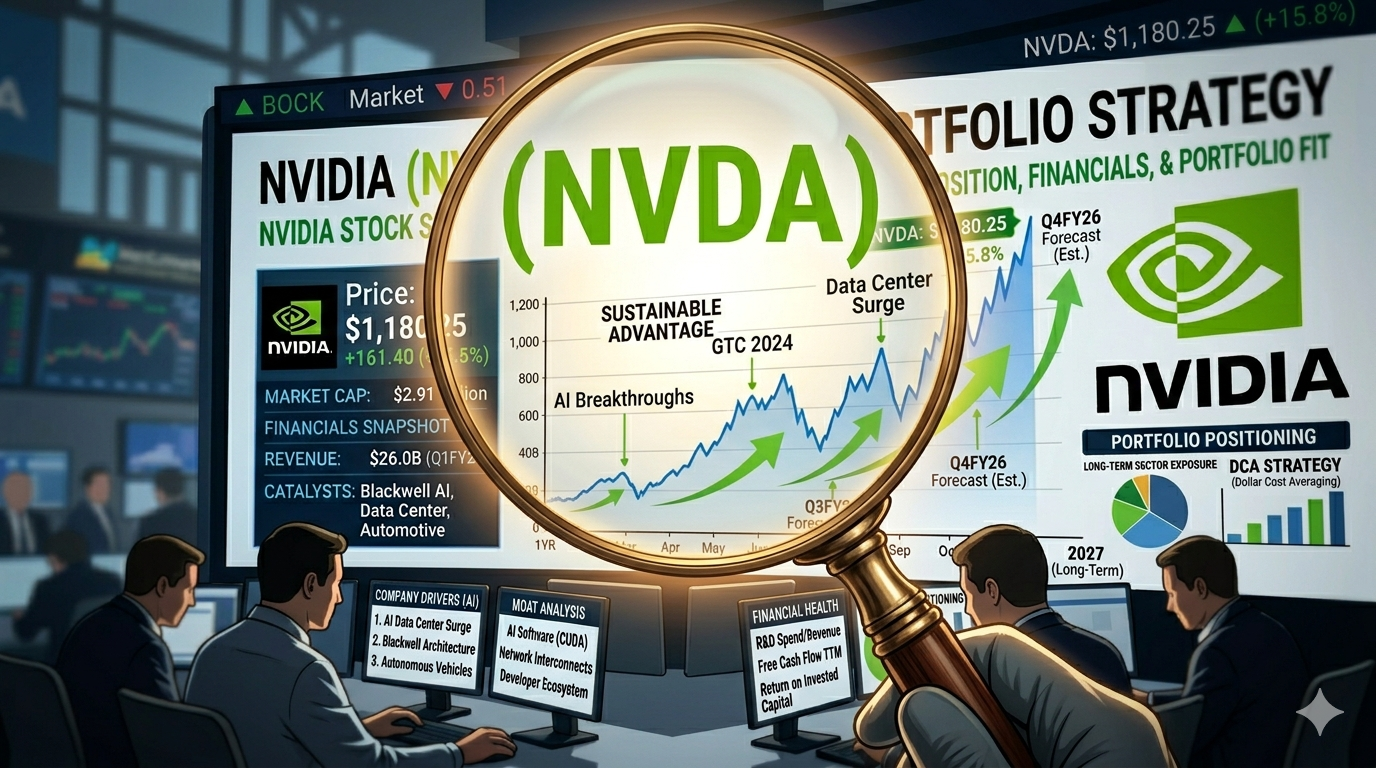
Eighty-six percent. That's Nvidia's slice of the GPU market — a level of dominance rare in any industry, let alone one growing this fast. The company just reported fiscal 2026 revenue of $215.9 billion, up 65% in a single year, almost entirely driven by data centers racing to build AI infrastructure.
Nvidia holds between 80% and 86% of the GPU market, leaving competitors like AMD and Intel fighting over the scraps.
Data centers fuel everything
Nvidia's growth story is simple to describe but staggering in scale. Ninety-two percent of its revenue now comes from data centers — the massive computing facilities that power everything from ChatGPT to Google's AI search. Companies like Microsoft, Amazon, and Meta are spending tens of billions of dollars per quarter on Nvidia's chips to train large language models and, increasingly, to run inference workloads — the process of actually using a trained AI model to generate answers, images, or predictions.
The latest product driving that demand is Blackwell, Nvidia's newest chip architecture. Blackwell is ramping up production now and is designed to handle both training and inference more efficiently than previous generations. As AI shifts from the expensive training phase to the inference phase — where models are deployed at scale — Nvidia is positioning itself to capture both sides of the market.
The moat competitors can't cross
Nvidia doesn't just lead the AI chip market — it dominates it in ways that are hard to replicate. AMD's data center GPU revenue grew in 2024, but it remains a fraction of Nvidia's scale. Intel is further behind, still working to prove its chips can compete on performance.
The real moat isn't just hardware — it's software. CUDA, Nvidia's programming platform, has been the standard for AI developers for over a decade. Switching to a competitor's chip often means rewriting code, retraining teams, and risking performance losses. That lock-in effect is reflected in Nvidia's gross margins: around 75%, compared to competitors in the 58% to 68% range. Nvidia isn't just selling chips — it's selling an ecosystem that's deeply embedded in how AI gets built.
Hyperscalers like Google and Amazon are designing their own custom AI chips to reduce dependence on Nvidia, but so far those efforts have barely dented demand. Most companies building AI infrastructure still choose Nvidia's hardware because it works, it's fast, and it's what their engineers already know.
The $205 question
The financials are undeniably strong. Nvidia reported fiscal 2026 revenue of $215.9 billion, a 65% jump year-over-year. First-quarter fiscal 2027 revenue came in at $81.6 billion, up 85% compared to the same quarter the prior year. Analysts surveyed have set an average price target around $298, well above the stock's current price near $205.
But context matters. Nvidia's stock trades at a premium valuation, meaning investors are paying a high multiple relative to earnings because they expect years of future growth. If AI demand slows, if competition heats up faster than expected, or if hyperscalers shift more spending to their own chips, that premium could evaporate quickly. Stocks priced for perfection rarely stay stable when expectations aren't met.
This article is for educational purposes only and does not constitute financial advice. Always do your own research before making any investment decisions.
Curious how analysts set price targets like the $298 figure for Nvidia? Our article on how Wall Street values growth stocks breaks down the methods behind the numbers.