What Happens to Markets During a Recession
Oil just crossed $100 a barrel. Inflation fears are climbing. And somewhere in the back of your mind, a question is forming: what happens to my money if the economy tips into a recession?
Recessions do not destroy all investments equally — and markets usually recover before the economy does.
The answer is not what most beginners expect. Different investments respond in completely different ways when growth stalls, unemployment rises, and consumer spending falls. Understanding these patterns won't predict the future, but it will help you make sense of what you're seeing when headlines turn dark.
Think of a recession as a forest fire
Not every tree burns at the same rate. Some species have thick bark and survive. Others ignite immediately. A few even need fire to release their seeds.
A recession works the same way across your portfolio. It's a period of economic contraction — typically defined as two consecutive quarters of declining GDP — and it doesn't treat all assets equally. Stocks, bonds, commodities, and cash each respond to different forces when the economy slows.
The key insight: recessions are not binary events where everything crashes at once. They're environments where the rules of what performs well temporarily shift.
What actually happens when growth stalls
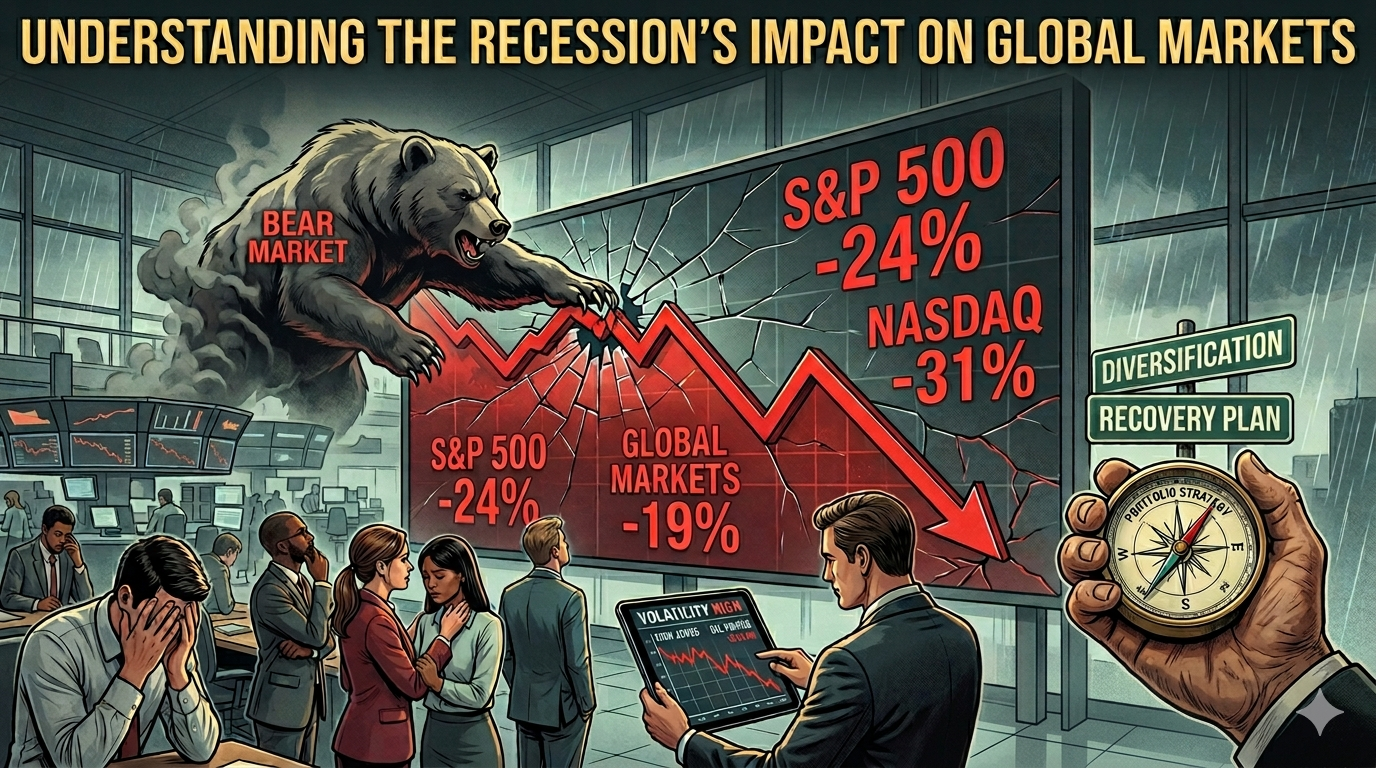
During recessions, stocks typically fall between 20% and 40% from their peak. But that average hides enormous variation. The 2020 COVID recession saw a sharp 34% drop that recovered in months. The 2008 financial crisis dragged markets down over 50% across eighteen months.
Why do stocks fall? Corporate earnings decline when consumers and businesses spend less. Unemployment rises, which means fewer paychecks and less demand. Investors react by repricing what future profits are worth today — and that repricing usually happens fast and early, often before the recession is officially declared.
But here's what surprises most beginners: the stock market typically bottoms out and begins recovering before the recession officially ends. Markets are forward-looking. They don't wait for unemployment to fall or GDP to turn positive. They move the moment investors believe the worst is priced in.
Not all stocks suffer equally
Inside the stock market, sector matters more than most beginners realize. During recessions, defensive sectors — healthcare, utilities, consumer staples — tend to hold up better because people still need medication, electricity, and groceries even when times are tough.
Cyclical sectors like travel, retail, construction, and financials usually get hit hardest. These industries depend on consumer confidence and discretionary spending, both of which evaporate when layoffs rise and uncertainty spreads.
Technology is harder to categorize. In some recessions it holds up well because software and cloud services have become essential infrastructure. In others, it falls sharply because growth stocks are especially sensitive to rising interest rates and falling revenue forecasts.
Bonds often move in the opposite direction
When stocks fall during a recession, bonds — especially government bonds — often rise. This happens for two reasons.
First, central banks typically cut interest rates during recessions to stimulate borrowing and spending. When rates fall, existing bonds with higher interest payments become more valuable. Second, investors flee to safety. Government bonds are seen as a stable place to park money when corporate profits are uncertain.
This is why diversification across asset classes matters. A portfolio holding both stocks and bonds doesn't just reduce risk by spreading it around — it holds assets that often move in opposite directions during downturns.
Commodities and cash play defense
Commodities like oil, copper, and industrial metals usually fall during recessions because demand from factories and consumers drops. But there are exceptions. Gold often rises because it's viewed as a store of value during uncertainty and inflation.
Cash becomes surprisingly powerful during recessions — not because it grows, but because it gives you optionality. When quality stocks are down 30% or 40%, cash lets you buy at discounted prices while others are forced to sell. It's not about earning a return. It's about having flexibility when fear is highest.
What to do with this
You can't predict when the next recession will arrive, but you can understand how different parts of your portfolio are likely to respond when it does. Stocks will likely fall, but not forever. Bonds may provide ballast. Defensive sectors may hold up better than cyclical ones. And markets will probably recover before the economic data turns positive.
The goal is not to panic or try to time the bottom. It's to know what you own, why you own it, and how it typically behaves when growth slows. That knowledge won't make recessions comfortable, but it will make them less confusing.
This article is for educational purposes only and does not constitute financial advice. Always do your own research before making any investment decisions.
Curious how to position a portfolio for uncertainty? Our article on diversification and why it matters walks through how mixing asset classes can reduce risk.