Why Strong Job Growth Can Actually Hurt Your Stock Portfolio
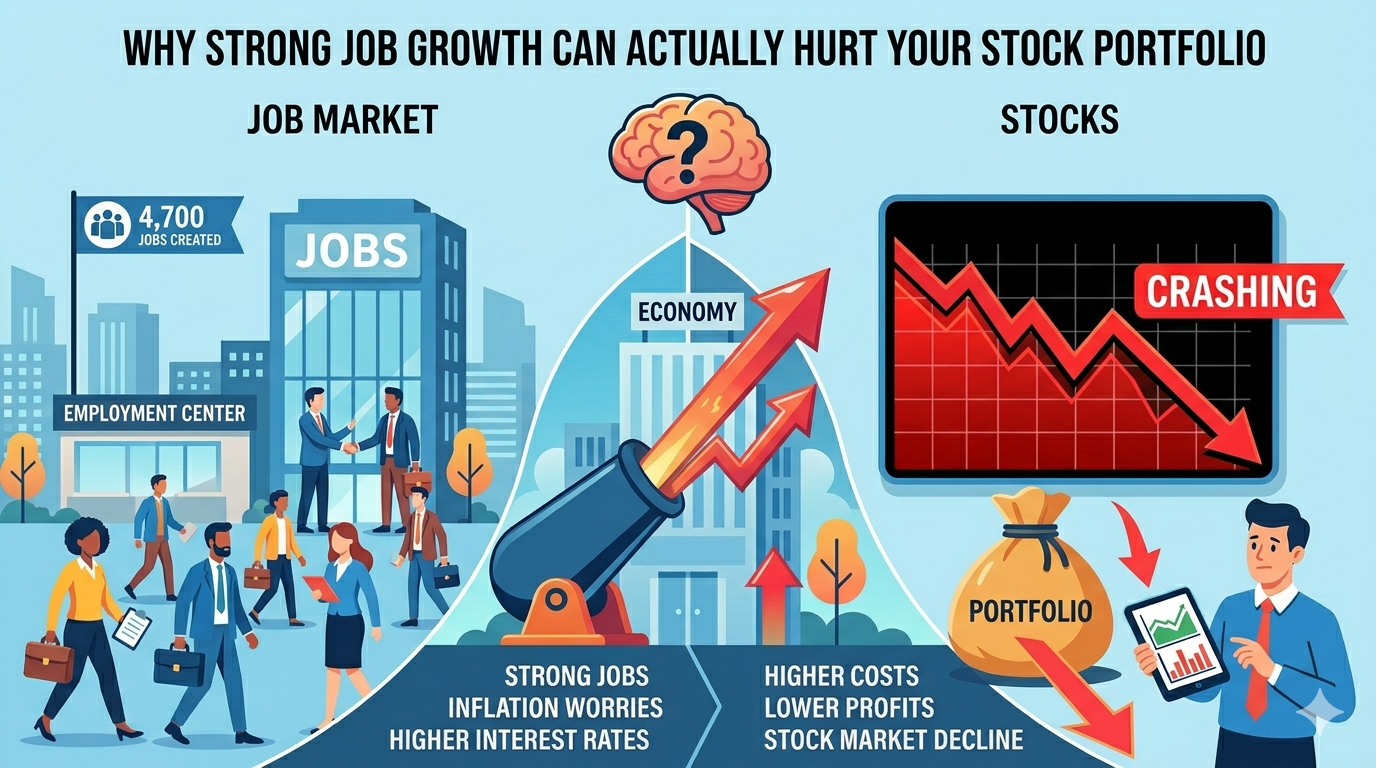
The US economy added 172,000 jobs in May 2026, and unemployment sits at a healthy 4.3%. That sounds like great news — until you check the stock market. Sometimes, the better the jobs report, the worse stocks perform.
Strong job growth is not bad for the economy — it is often bad for stocks, because it signals inflation risk and higher interest rates ahead.
For new investors, this feels backwards. But the stock market cares less about how the economy is doing today and more about what the Federal Reserve will do tomorrow. Here's how a thriving job market can actually work against your portfolio.
Jobs up, stocks down: the counterintuitive logic
When more people are working, they have more money to spend. That drives up demand for goods and services. And when demand outpaces supply, prices rise — that's inflation.
The Federal Reserve fights inflation by raising interest rates. Higher rates make borrowing more expensive for companies, which can slow business expansion and squeeze profit margins. They also make bonds more attractive relative to stocks, pulling money out of the market.
So a booming jobs report doesn't just signal economic strength. It signals that the Fed might step in to cool things down. That's when stock prices start to fall — not because the economy is weak, but because investors expect tighter policy ahead.
Why the Fed watches the jobs report so closely
Employment data is one of the Fed's most important economic gauges. Strong hiring suggests businesses are confident and wages may be rising. Rising wages can fuel inflation, especially if they outpace productivity.
The Fed has a dual mandate: maximize employment and stabilize prices. When unemployment is low and job growth stays strong, the Fed shifts focus to inflation. That's when rate hikes become more likely.
Investors know this. So they react not to the jobs number itself, but to what it means for monetary policy. A hot jobs report can trigger a sell-off if traders believe it increases the odds of another rate increase.
The market prices in the future, not the present
Stock prices reflect expectations, not current conditions. When you buy a share, you're betting on future earnings — often years down the line. If investors believe rates will rise, they discount those future earnings more heavily.
That's why good economic news can feel like bad news for your portfolio. The market isn't confused. It's forward-looking. A strong economy today can mean a restrictive Fed tomorrow, and that changes the math on what stocks are worth right now.
This is also why stocks sometimes rally on weak jobs data. If hiring slows, the Fed may pause rate hikes or even cut rates. That boosts stock valuations, even if the underlying economy looks shakier.
What this means when you're reading headlines
Next time you see a headline celebrating robust job growth followed by a market dip, you'll know why. The economy and the stock market are not the same thing. One measures current activity. The other prices in future risk.
Understanding this disconnect helps you avoid panic. A drop after strong jobs data doesn't mean something is broken. It means the market is recalibrating based on what it expects the Fed to do next.
You don't need to trade on every jobs report. But knowing how employment data influences rate expectations — and how those expectations move stock prices — gives you a clearer picture of what's driving your portfolio on any given day.
This article is for educational purposes only and does not constitute financial advice. Always do your own research before making any investment decisions.
Curious how interest rates actually move stock prices? Our article on how the Federal Reserve influences your portfolio explains the mechanics step by step.